F1TENTH Autonomous Race Car
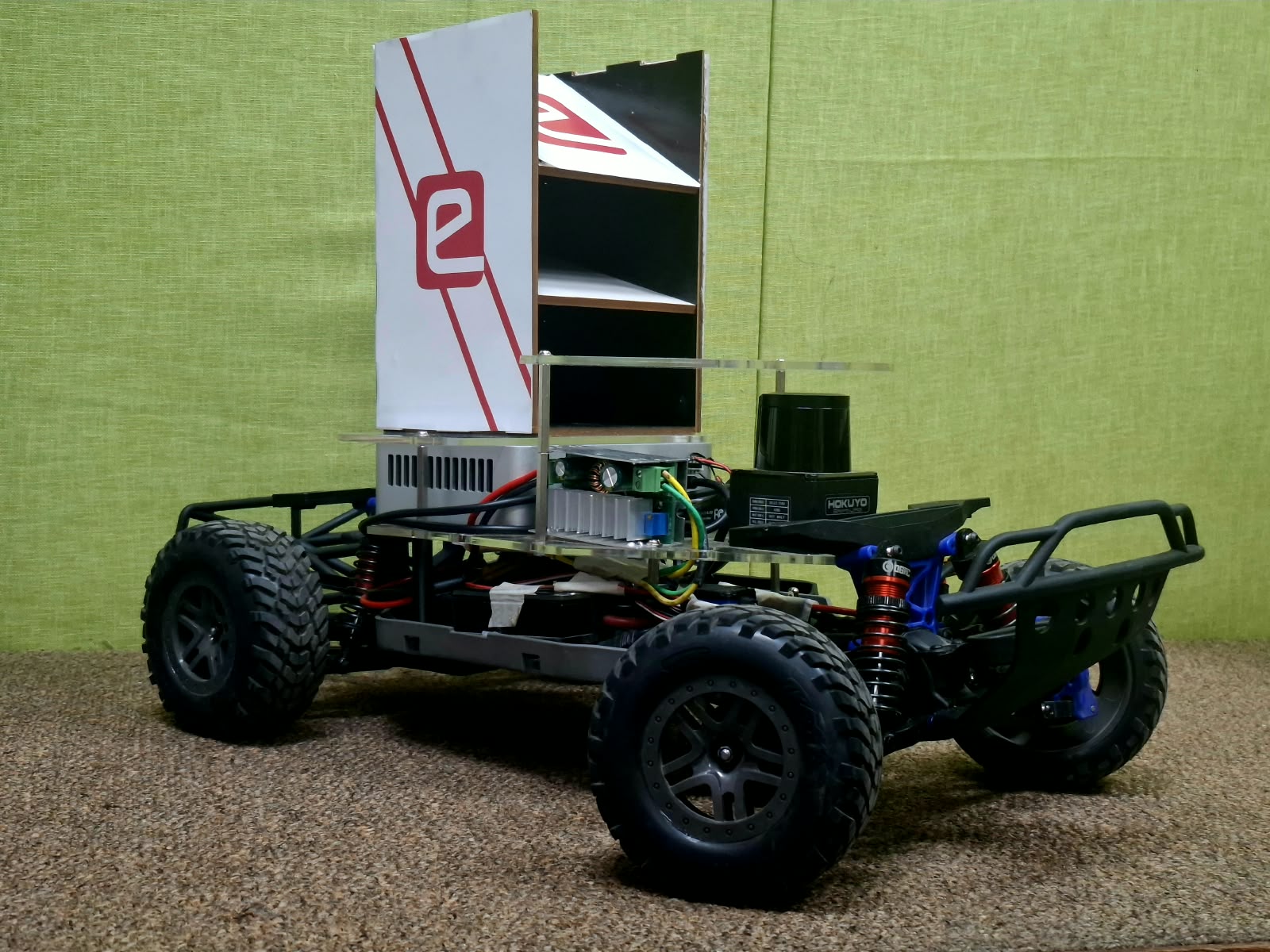
Overview
An autonomous 1/10-scale F1TENTH race car running ROS 2 Humble. The software stack includes a custom fused odometry node, an offline minimum-curvature raceline optimizer, and several racing controllers (Stanley with VFH obstacle avoidance, MPPI, and kinematic MPC). All of the controllers follow a raceline generated from a SLAM map of the track.
Salient Features
- Stanley Controller with VFH (Primary):
- The Stanley steering law uses a track-width-normalized gain, so it corrects harder near walls and more gently on wide straights. It runs deterministically in under 1 ms per cycle.
- Curvature-based dynamic braking computes corner speeds ahead of time and brakes before slow corners.
- A Vector Field Histogram layer steers around unplanned obstacles seen on the LiDAR, such as other cars or debris.
- Offline Raceline Optimization:
- A planner in the style of TUM’s global_racetrajectory_optimization goes from a SLAM occupancy grid to a race-ready trajectory.
- Pipeline: safe corridor extraction, then skeletonization, then a minimum-curvature QP, then a periodic cubic spline, then a friction-circle velocity profile with forward and backward passes.
- MPPI Controller:
- Standalone Model Predictive Path Integral controller that samples 4096 rollouts over a 60-step horizon at 20 Hz. Each rollout is scored on cross-track error, speed, heading and an exponential wall penalty.
- Kinematic MPC (Experimental):
- Receding-horizon MPC on a kinematic bicycle model, kept as a test bench with an instrumented debug node.
- Raceline Speed Editor:
- An interactive Tkinter/matplotlib tool for hand-tuning the speed profile. You can boost straights or slow specific corners without re-running the planner.
Custom Odometry: good_odom
Raw VESC wheel odometry integrates its own noisy yaw from the steering angle and ERPM. That estimate drifts badly over a lap, so the map-frame localization ends up fighting the odometry. The good_odom node keeps the best part of each sensor:
- Position comes from the wheel encoder distance travelled.
- Orientation comes from the VESC’s onboard IMU yaw, which is effectively drift-free over a lap.
The node dead-reckons position along the IMU heading. This gives a straighter, lower-drift odom -> base_link estimate, which keeps the localization correction small and gives the controllers a stable pose to track.
Hardware & Driver Stack
- Hokuyo LiDAR for localization and obstacle detection.
- VESC motor controller for motor ERPM and servo control, which also provides wheel odometry and the onboard IMU.
- ExpressLRS (ELRS) RC link through a custom CRSF teleop bridge, with dedicated deadman, autonomous-enable, direction and boost switches. Flipping the deadman switch down is a global E-stop at any time.
- Ackermann Mux arbitrates between teleop and autonomous commands, so the RC deadman always takes priority over autonomy.
- Custom 3D printed and laser cut chassis plates, with mounts for the compute unit, VESC and tracker.